Saussure’s Sign
By Steve Hoenisch
Copyright 1996-2026 www.Criticism.Com
First published in 1998.
Download Essay in
PDF
Table of Contents
1 THE SIGN, THE SIGNIFIER, AND THE SIGNIFIED
2 LEXICON
3 SIGN VS. SYMBOL
4 MISTAKES
5 EXPANSION BEYOND LANGUAGE
6 A FINAL WORD: THE INDETERMINANCY OF MEANING
7 REFERENCES
8 RELATED
1 THE SIGN, THE SIGNIFIER, AND THE SIGNIFIED
The sign, the signifier, and the signified are concepts of the school
of thought known as structuralism, founded
by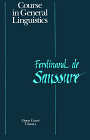 Ferdinand de
Saussure, a Swiss linguist, during lectures he gave between 1907 and
1911 at the University of Geneva. His views revolutionized the study of
language and inaugurated modern linguistics. The theory also profoundly
influenced other disciplines, especially anthropology, sociology, and
literary criticism. The central tenet of structuralism is that the
phenomena of human life, whether language or media, are not intelligible
except through their network of relationships, making the sign and the
system (or structure) in which the sign is embedded primary concepts. As
such, a sign — for instance, a word — gets its meaning only in relation
to or in contrast with other signs in a system of signs.
Ferdinand de
Saussure, a Swiss linguist, during lectures he gave between 1907 and
1911 at the University of Geneva. His views revolutionized the study of
language and inaugurated modern linguistics. The theory also profoundly
influenced other disciplines, especially anthropology, sociology, and
literary criticism. The central tenet of structuralism is that the
phenomena of human life, whether language or media, are not intelligible
except through their network of relationships, making the sign and the
system (or structure) in which the sign is embedded primary concepts. As
such, a sign — for instance, a word — gets its meaning only in relation
to or in contrast with other signs in a system of signs.
In general, the signifier and the signified are the components of the sign, itself formed by the associative link between the signifier and signified. Even with these two components, however, signs can exist only in opposition to other signs. That is, signs are created by their value relationships with other signs. The contrasts that form between signs of the same nature in a network of relationships is how signs derive their meaning. As the translator of Saussure’s Course in General Linguistics, Roy Harris, puts it:
“The essential feature of Saussure’s linguistic sign is that, being intrinsically arbitrary, it can be identified only by contrast with coexisting signs of the same nature, which together constitute a structured system” (p. x).
In Saussure’s theory of linguistics, the signifier is the sound and the signified is the thought. The linguistic sign is neither conceptual nor phonic, neither thought nor sound. Rather, it is the whole of the link that unites sound and idea, signifier and signified. The properties of the sign are by nature abstract, not concrete. Saussure: “A sign is not a link between a thing and a name, but between a concept and a sound pattern” (Course, p. 66).
2 LEXICON
At least two other terms are used for signifier and
signified:
signifier = signal = signifiant
signified = signification = signifie
3 SIGN VS. SYMBOL
Saussure choose the term “sign” over “symbol” because the latter implies motivation. For Saussure, the sign is arbitrary. Virtually all signs, Saussure maintains, have only arbitrarily ascribed meanings. Since Saussure, this notion has been taken as axiomatic in Western linguistics and philosophy.
4 MISTAKES
A common mistake is to construe the signifier and the sign as the
same thing. In my view, another common mistake, perhaps related to the
first, is to speak of a signifier without a signified or a sign, or to
speak of a signified without a signifer or a sign. Used in reference to
Saussure’s original  formulations, both locutions are nonsensical. In language, a lone
signifier would be an utterly meaningless sound or concatenation of
sounds. But it is even more absurd to speak of a signified without
signifier or sign: It would, I believe, have to be a sort of half
thought, something never thought before, a thought that exists solely
outside the domain of language, a fleeting, private, chaotic thought
that makes no sense even to the thinker — an unthought. Another mistake
is to endow a sign with meaning outside the presence of other signs.
Except as part of the whole system, signs do not and cannot exist.
formulations, both locutions are nonsensical. In language, a lone
signifier would be an utterly meaningless sound or concatenation of
sounds. But it is even more absurd to speak of a signified without
signifier or sign: It would, I believe, have to be a sort of half
thought, something never thought before, a thought that exists solely
outside the domain of language, a fleeting, private, chaotic thought
that makes no sense even to the thinker — an unthought. Another mistake
is to endow a sign with meaning outside the presence of other signs.
Except as part of the whole system, signs do not and cannot exist.
5 EXPANSION BEYOND LANGUAGE
Saussure provides an explicit basis for the expansion of his science of signs beyond linguistics: “It is possible,” he says, “to conceive of a science which studies the role of signs as part of social life. … We shall call it semiology. It would investigate the nature of signs and the laws governing them. Since it does not yet exist, one cannot say for certain that it will exist. But it has a right to exist, a place ready for it in advance.”
Roland Barthes is one scholar who took Saussure’s counsel to heart.
He helped found the modern science
of semiology, applying
structuralism to the “myths” he saw all around him: media, fashion, art,
photography, architecture, and especially literature. For Barthes, “myth
is a system of communication.” It is a “message,” a “mode of
signification,” a “form” (Mythologies, p. 109). With a plethora of
complexities and nuances, Barthes extends Saussure’s structuralism and
applies it to myth as follows:
semiology, applying
structuralism to the “myths” he saw all around him: media, fashion, art,
photography, architecture, and especially literature. For Barthes, “myth
is a system of communication.” It is a “message,” a “mode of
signification,” a “form” (Mythologies, p. 109). With a plethora of
complexities and nuances, Barthes extends Saussure’s structuralism and
applies it to myth as follows:
“Myth is a peculiar system, in that it is constructed from a semiological chain which existed before it: it is a second-order semiological system. That which is a sign (namely the associative total of a concept and an image) in the first system, becomes a mere signifier in the second. We must here recall that the materials of mythical speech (the language itself, photography, painting, posters, rituals, objects, etc.), however different at the start, are reduced to a pure signifying function as soon as they are caught by myth” (Mythologies, p. 114).
Because of the complexities and nuances of Barthes’s semiology, I will stop here and let you pick up the strand for yourself by reading the highly informative chapter “Myth Today” in Mythologies.
6 A FINAL WORD: THE INDETERMINANCY OF MEANING
 Regardless of how
linguistic signs (and perhaps other signs, too) are analyzed, meaning
may in fact be unrecoverable, both to the analyst and to the
participants in an exchange of signs. It is my belief that meaning is
indeed ultimately indeterminate, a position that bodes well with what
very well be a fact of language. With respect to indeterminacy, some
linguists, postmodern theorists, and analytic philosophers seem to be in
agreement. Brown and Yule, both of whom are linguists, write that “the
perception and interpretation of each text is essentially
subjective.”
Regardless of how
linguistic signs (and perhaps other signs, too) are analyzed, meaning
may in fact be unrecoverable, both to the analyst and to the
participants in an exchange of signs. It is my belief that meaning is
indeed ultimately indeterminate, a position that bodes well with what
very well be a fact of language. With respect to indeterminacy, some
linguists, postmodern theorists, and analytic philosophers seem to be in
agreement. Brown and Yule, both of whom are linguists, write that “the
perception and interpretation of each text is essentially
subjective.”
The postmodern theorists, meantime, hold that every decoding is
another encoding. Jacques Derrida, for example, maintains that the
possibility of interpretation and reinterpretation is endless, with
meaning getting any provisional significance only from speaker, hearer,
or observer: Meaning is
necessarily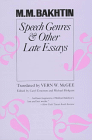 projection.
Bakhtin, too, says “the interpretation of symbolic structures is forced
into an infinity of symbolic contextual meanings and therefore it cannot
be scientific in the way precise sciences are scientific.”
projection.
Bakhtin, too, says “the interpretation of symbolic structures is forced
into an infinity of symbolic contextual meanings and therefore it cannot
be scientific in the way precise sciences are scientific.”
Both Bakhtin’s and Derrida’s views are surprisingly not unlike those of W. V. O. Quine’s in “The Indeterminacy of Translation,” where Quine argued that “the totality of subjects’ behavior leaves it indeterminate whether one translation of their sayings or another is correct.”
Wittgenstein pays homage to the indeterminacy of meaning as well:
“Any interpretation still hangs in the
air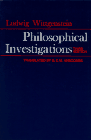 along with what it
interprets, and cannot give it any support. Interpretations by
themselves do not determine meaning.”
along with what it
interprets, and cannot give it any support. Interpretations by
themselves do not determine meaning.”
7 REFERENCES
Roland Barthes, Mythologies, trans. Annette Lavers (New York: Hill and Wang, 1972).
Ferdinand de Saussure, Course in General Linguistics, trans. Roy Harris (La Salle, Ill.: Open Court, 1983).
See also Roland Barthes’s Elements of Semiology.