Philosophy at Criticism.Com
1 Philosophy
Max
Weber’s View of Objectivity in Social Science
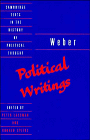 Did Weber believe that, even though facts are one thing and values
another, social and economic facts could be evaluated without the
analysis being influenced by values? And what is the relation of
objectivity to values? Could objectivity, for instance, be used to show
that one value is superior to another? Or does objectivity apply only to
the analysis of facts? Do one’s values or perspective stem from human
nature, metaphysical views, personal identity, or is it just as likely
that they are a mere construct of culture? Read on …
Did Weber believe that, even though facts are one thing and values
another, social and economic facts could be evaluated without the
analysis being influenced by values? And what is the relation of
objectivity to values? Could objectivity, for instance, be used to show
that one value is superior to another? Or does objectivity apply only to
the analysis of facts? Do one’s values or perspective stem from human
nature, metaphysical views, personal identity, or is it just as likely
that they are a mere construct of culture? Read on …
Interpretation and
Indeterminancy in Discourse Analysis
 Throughout the essay,
I will argue a hard line: the exact meaning of a speaker’s utterance in
a contextualized exchange is often indeterminate. Within the context of
the analysis of the teacher-pupil exchange, I will argue for the
superiority of interactional linguistics over speech act theory because
it reduces the indeterminacy and yields a more principled
interpretation, especially when the interactional approach is
complemented by elements from other sociologically influenced methods,
namely the ethnography of communication and Labovian sociolinguistics.
Read on …
Throughout the essay,
I will argue a hard line: the exact meaning of a speaker’s utterance in
a contextualized exchange is often indeterminate. Within the context of
the analysis of the teacher-pupil exchange, I will argue for the
superiority of interactional linguistics over speech act theory because
it reduces the indeterminacy and yields a more principled
interpretation, especially when the interactional approach is
complemented by elements from other sociologically influenced methods,
namely the ethnography of communication and Labovian sociolinguistics.
Read on …
Habermas’ Theory of Discourse Ethics
The purpose of this essay is to reveal the central distinctive elements of Jürgen Habermas’ theory of discourse ethics and how his moral theory differs from those of two other prominent philosophers, Immanuel Kant and John Rawls. In unveiling the distinctive qualities of Habermas’ discourse ethics, the fundamental difference between it and Kant’s moral theory, upon which Habermas in part bases his thought, will be explained. Next, in exposing another distinctive element of discourse ethics, a pivotal difference between Habermas’ moral theory and John Rawls’ theory of justice will be elucidated. Read on …
Hermogenes Was Right, Socrates Wrong In Harris and Taylor’s chapter on Plato’s “Cratylus” in Landmarks in Linguistic Thought, Cratylus takes the position that the form and meaning of a word are inextricably related. For Cratylus, “everything,” including Hermogenes, “has a right name of its own, which comes by nature” even though some people, like Hermogenes, are named incorrectly (Cratylus 383, as quoted in Harris and Taylor, p. 1). Read on …
2 Wittgenstein
The Myth of Psychoanalysis: Wittgenstein Contra Freud My central thesis is that if, as Wittgenstein says, Freudian psychoanalysis is based in myth, its application to actual psychological problems does not, indeed cannot, resolve them. Instead, all it can do is clarify them or present them in a different light. Implicit in my argument is that this is how Wittgenstein thought of the results of psychoanalysis, much like he thought of the application of his philosophical technique to philosophical problems, especially those of metaphysics, ethics, and aesthetics. As such, Wittgenstein is also subverting a larger myth: that the insights gained in psychoanalysis lead to the scientific resolution of psychological problems. Read on …
Wittgenstein and Freud: Points of Contact and Criticism
A Wittgensteinian
Approach to Discourse Analysis This essay seeks to take
Wittgenstein’s influence on discourse analysis a step further by using
his writings as the theoretical foundation for an approach to analyzing
discourse that is distinct from speech act theory,

 which stems from the
analytic tradition in philosophy, and to suggest that a
Wittgenstein-inspired approach may actually be closer in spirit and
content to that of an unlikely candidate whose views, in contrast to the
analytic school, harbor a distinctly Continental flavor which has come
to influence critical theory: Mikhail Bakhtin. Read on …
which stems from the
analytic tradition in philosophy, and to suggest that a
Wittgenstein-inspired approach may actually be closer in spirit and
content to that of an unlikely candidate whose views, in contrast to the
analytic school, harbor a distinctly Continental flavor which has come
to influence critical theory: Mikhail Bakhtin. Read on …
A Scientific Analysis of Desire?
Interpreting Passage 79 of Wittgenstein’s Philosophical Investigations
Freud’s Notion of Subconscious as a “Means of Representation”
Wittgenstein: A Disciple of Freud?
Notes from a Presentation on Wittgenstein and Freud
Psychoanalysis as Weltanschauung
Freud Rebuts Wittgenstein on Verifiability
Philosophy Becomes Psychotherapy
3 Social and Political Philosophy
The Relation Between Civic Society and Newspapers in the Writings of Alexis de Tocqueville and Robert Putnam The purpose of this essay is to demonstrate how Robert Putnam’s findings in Making Democracy Work and in a later study he published on civic participation in the United States, “The Strange Disappearance of Civic America,” support Tocqueville’s views. This will be accomplished in two steps. The first will examine whether the specific views of Tocqueville regarding associations and newspapers and the relations between them are borne out in Putnam’s findings. The second step will examine how Putnam’s findings support Tocqueville’s central hypothesis: That equality is the fundamental condition in a democracy from which others are derived. A final section of the essay will specify several normative implications that may be drawn from Putnam’s findings, especially those outlined in “The Strange Disappearance of Civic America.” Read on …
Durkheim on Educational Systems In Emile Durkheim’s view, educational systems reflect underlying changes in society because the systems are a construct built by society, which naturally seeks to reproduce its collectively held values, beliefs, norms, and conditions through its institutions. Thus, as time unfolds, educational systems come to contain the imprint of past stages in the development of society, as each epoch leaves its imprint on the system. By uncovering these imprints and analyzing them, the development of a society can be reconstructed from the educational system. Read on …
4 Max Weber
Max
Weber’s View of Objectivity in Social Science
Max Weber’s Interest in Studying Capitalism
Goals in Reading Max Weber’s Early Works
5 Media Theory and Criticism
Media Criticism and Theory Page
- An Analysis of Kellner’s Theory of Media Culture
- Book Review of Read All About It: The Corporate Takeover of America’s Newspapers
- Foucault: A Lover’s Discourse about Madness and the Media
- Image over Substance: An Example of Postmodern Politics
- Relation Between Civic Society and Newspapers in the Writings of Alexis de Tocqueville and Robert Putnam
- Why Can’t We Stop Watching TV?
6 Critical Theory
- A Scientific Analysis of Desire?
- Freud’s Notion of Subconscious as a “Means of Representation”
- Goals in Reading Max Weber’s Early Works
- Habermas’ Theory of Discourse Ethics
- Max Weber’s Interest in Studying Capitalism
- Max Weber’s View of Objectivity in Social Science
- Philosophy Becomes Psychotherapy
- Psychoanalysis as Weltanschauung
- The Myth of Psychoanalysis: Wittgenstein Contra Freud
- Wittgenstein and Freud: Points of Contact and Criticism