Media Criticism, Media Theory, and Media Culture
1 Media Criticism
Image over
Substance: An Example of Postmodern Politics: Max Horkheimer and
Theodor Adorno, commenting on Hitler’s propagandistic use of the radio,
note “the gigantic fact that the speech that penetrates everywhere
replaces its content,”1 a formula that has been taken one step further
by television: On TV, the image
dominates, overpowering
not only the fact of speech but also its content. Read more …
overpowering
not only the fact of speech but also its content. Read more …
Why Can’t We Stop Watching TV? Roland Barthes, writing in The Pleasure of the Text, has an explanation for a befuddling recurrence: Why so many people, including myself, watch so much bad TV even when we know it is awful. Barthes’s answer: pleasure. He elaborates thus: Read more …
 Principles of Media
Criticism: Media criticism is in an undeveloped state, today,
largely because the mainstream media allows virtually no open discussion
of the subject. Some criticism does get to the public, of course, but
most of it is corrupted by the same forces that have turned the rest of
the media into a source of manipulation. (By Ken Sanes, ) Read more …
Principles of Media
Criticism: Media criticism is in an undeveloped state, today,
largely because the mainstream media allows virtually no open discussion
of the subject. Some criticism does get to the public, of course, but
most of it is corrupted by the same forces that have turned the rest of
the media into a source of manipulation. (By Ken Sanes, ) Read more …
Book Review of
Read All About It: The Corporate Takeover of America’s Newspapers:
 Read All About It:
The Corporate Takeover of America’s Newspapers is an institutional
acknowledgement of what many wary readers have known for years:
Corporate control is ruining our daily newspapers. Read more …
Read All About It:
The Corporate Takeover of America’s Newspapers is an institutional
acknowledgement of what many wary readers have known for years:
Corporate control is ruining our daily newspapers. Read more …
2 Media Theory
Foucault: A
Lover’s Discourse about Madness and the Media: Roland Barthes,
writing in the early 1970s, begins The Pleasure of the Text
with these words:  Read more …
An Analysis of
Kellner’s Theory of Media Culture:
 In an era when the
media have grown to be one of the most dominant forms of culture in
North American – so dominant, in fact, that the they can now be seen as
the pinnacle of commercial culture – an explanatory theory of the media
becomes paramount. Yet considering the intimate relationship between
culture and media and that, for many, the media have become their
culture, a theory that views the media outside the context of culture
will be afflicted with myopia. Thus, for completeness, a theory of the
media requires a firm connection to culture in its every step. Douglas
Kellner, in his book Media Culture: Cultural Studies, Identity and
Politics Between the Modern and the Postmodern, sets out to make these
connections. Read more …
In an era when the
media have grown to be one of the most dominant forms of culture in
North American – so dominant, in fact, that the they can now be seen as
the pinnacle of commercial culture – an explanatory theory of the media
becomes paramount. Yet considering the intimate relationship between
culture and media and that, for many, the media have become their
culture, a theory that views the media outside the context of culture
will be afflicted with myopia. Thus, for completeness, a theory of the
media requires a firm connection to culture in its every step. Douglas
Kellner, in his book Media Culture: Cultural Studies, Identity and
Politics Between the Modern and the Postmodern, sets out to make these
connections. Read more …
Why Can’t We Stop Watching TV? Roland Barthes, writing in The Pleasure of the Text, has an explanation for a befuddling recurrence: Why so many people, including myself, watch so much bad TV even when we know it is awful. Barthes’s answer: pleasure. He elaborates thus: Read more …
Saussure’s
Sign: The sign, the signifier, and the signified are concepts of the
school of thought known as structuralism, founded
by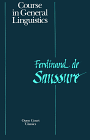 Ferdinand de
Saussure, a Swiss linguist, during lectures he gave between 1907 and
1911 at the University of Geneva. His views revolutionized the study of
language and inaugurated modern linguistics. The theory also profoundly
influenced other disciplines, especially anthropology, sociology, and
literary criticism. The central tenet of structuralism is that the
phenomena of human life, whether language or media, are not intelligible
except through their network of relationships, making the sign and the
system (or structure) in which the sign is embedded primary concepts. As
such, a sign – for instance, a word – gets its meaning only in relation
to or in contrast with other signs in a system of signs. Read more …
Ferdinand de
Saussure, a Swiss linguist, during lectures he gave between 1907 and
1911 at the University of Geneva. His views revolutionized the study of
language and inaugurated modern linguistics. The theory also profoundly
influenced other disciplines, especially anthropology, sociology, and
literary criticism. The central tenet of structuralism is that the
phenomena of human life, whether language or media, are not intelligible
except through their network of relationships, making the sign and the
system (or structure) in which the sign is embedded primary concepts. As
such, a sign – for instance, a word – gets its meaning only in relation
to or in contrast with other signs in a system of signs. Read more …
Using French Social Thought for Media Criticism With a focus on Althusser, Barthes, and Foucault, this essay broadly delineates the theoretical approaches of the three schools in explaining the role of the mass media in society. As I proceed, I enumerate several strengths and weaknesses of each theory and make some comparisons among them. Read more …
3 Media Culture
Why Can’t We Stop Watching TV? Roland Barthes, writing in The Pleasure of the Text, has an explanation for a befuddling recurrence: Why so many people, including myself, watch so much bad TV even when we know it is awful. Barthes’s answer: pleasure. He elaborates thus: Read more …
Live Show:
The Connotations of Visual Signs:
 “The level of
connotation of the visual sign, of its contextual reference and
positioning in different discursive fields of meaning and association,
is the point where already coded signs intersect with the deep semantic
codes of a culture and take on additional, more active ideological
dimensions,” Stuart Hall writes in his essay
“Encoding/decoding.”1 I almost know what he means. Read more …
“The level of
connotation of the visual sign, of its contextual reference and
positioning in different discursive fields of meaning and association,
is the point where already coded signs intersect with the deep semantic
codes of a culture and take on additional, more active ideological
dimensions,” Stuart Hall writes in his essay
“Encoding/decoding.”1 I almost know what he means. Read more …
4 Newspapering
Relation Between Civic Society and Newspapers in the Writings of Alexis de Tocqueville and Robert Putnam: The purpose of this essay is to demonstrate how Robert Putnam’s findings in Making Democracy Work and in a later study he published on civic participation in the United States, “The Strange Disappearance of Civic America,” support Tocqueville’s views. This will be accomplished in two steps. The first will examine whether the specific views of Tocqueville regarding associations and newspapers and the relations between them are borne out in Putnam’s findings. The second step will examine how Putnam’s findings support Tocqueville’s central hypothesis: That equality is the fundamental condition in a democracy from which others are derived. A final section of the essay will specify several normative implications that may be drawn from Putnam’s findings, especially those outlined in “The Strange Disappearance of Civic America.” Read more
The Future of American Newspapers: A Forecast Written in 1991
Motivations for News Language Style: Audience Perception or Cultural Orientation
The Mythological Language Of American Newspapers